Long Short-Term Memory
Creator: Petar Veličković (original)
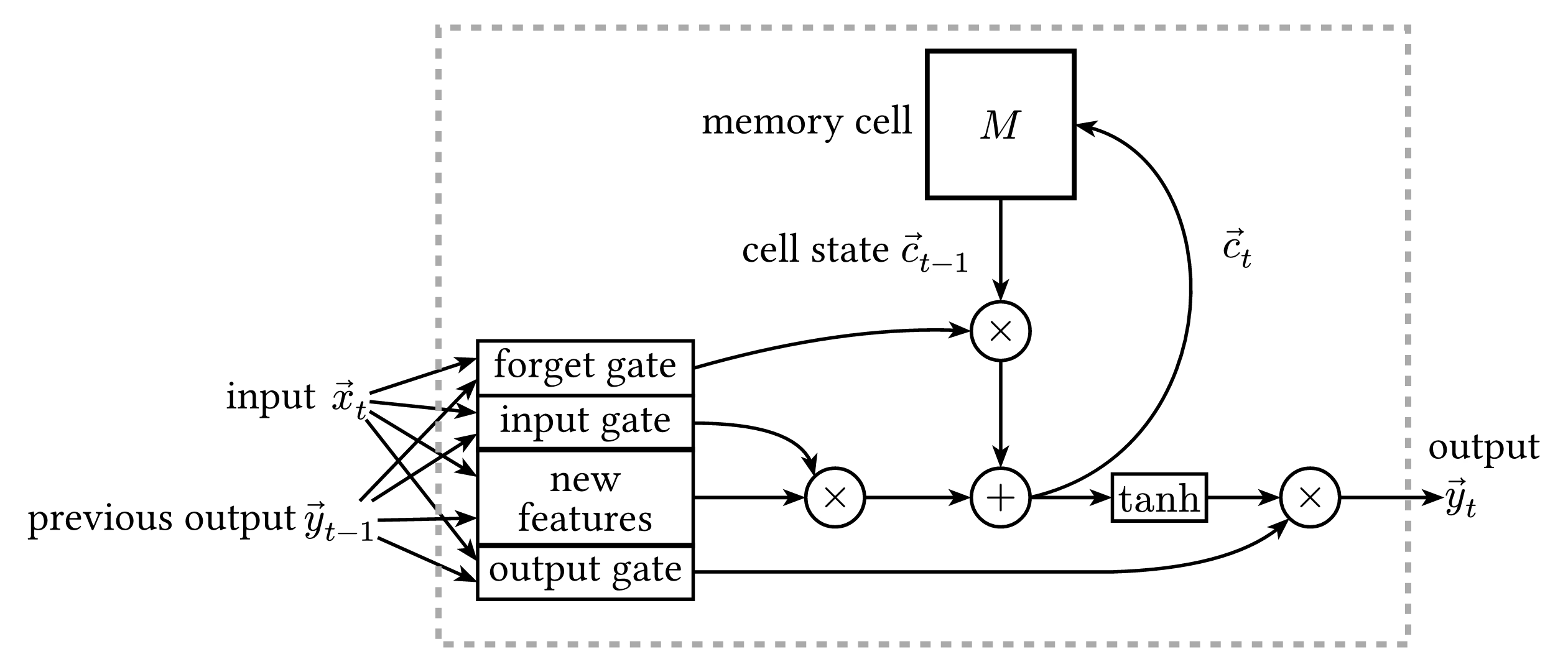
An LSTM block gates new features through input, forget, and output gates that control reads from and writes to the memory cell carrying the cell state between time steps.
Download
Code
#import "@preview/cetz:0.5.3": canvas, draw
#import draw: bezier, circle, content, line, rect

#set page(width: auto, height: auto, margin: 8pt, fill: none)
#set text(size: 12pt)

#canvas({
  let arr = (mark: (end: "stealth", fill: black, scale: .7), stroke: black + 1pt)

  // === gate stack on the left ===
  for (center-y, height, label, name) in (
    (1.32, .56, [forget gate], "fg"),
    (.76, .56, [input gate], "ig"),
    (0, 1.0, align(center, par(leading: 0.3em)[new\ features]), "ft"),
    (-.76, .56, [output gate], "og"),
  ) {
    rect((-1.1, center-y - height / 2), (1.1, center-y + height / 2), stroke: 1pt, name: name)
    content(name, label)
  }

  // === inputs fanning into all four gates ===
  content((-2.4, 1.0), $arrow(x)_t$, name: "x")
  content((-2.75, 1.0), [input], anchor: "east")
  content((-2.5, -.24), $arrow(y)_(t - 1)$, name: "y")
  content((-2.95, -.24), [previous output], anchor: "east")
  for (src, dy) in (("x", .21), ("y", -.21)) {
    line(src, (rel: (0, dy), to: "ft.west"), ..arr)
    for tgt in ("fg", "ig", "og") {
      line(src, (rel: (0, dy / 2), to: tgt + ".west"), ..arr)
    }
  }

  // === cell pipeline ===
  for (pos, label, name) in (
    ((2.55, 0), $times$, "t1"),
    ((4.24, 0), $+$, "pl"),
    ((7.4, 0), $times$, "t2"),
    ((rel: (0, 1.7), to: "pl"), $times$, "t3"),
  ) {
    circle(pos, radius: .3, stroke: 1pt, name: name)
    content(name, label)
  }
  rect((5.38, -.24), (6.34, .24), stroke: 1pt, name: "th")
  content("th", $tanh$)
  content((8.95, 0), $arrow(y)_t$, name: "y1")
  content((8.6, .3), [output], anchor: "south-west")
  rect((rel: (-.75, 1.36), to: "t3"), (rel: (1.5, 1.5)), stroke: 1.4pt, name: "M")
  content("M", $M$)
  content((rel: (-.15, 0), to: "M.west"), [memory cell], anchor: "east")

  for (from, to) in (
    ("ft", "t1"),
    ("t1", "pl"),
    ("pl", "th"),
    ("th", "t2"),
    ("t2", "y1"),
    ("M", "t3"),
    ("t3", "pl"),
  ) {
    line(from, to, ..arr)
  }
  content((rel: (-.29, .8), to: "t3"), [cell state $arrow(c)_(t - 1)$], anchor: "east")

  // input gate bends up into the first product
  bezier("ig.east", (rel: (-.21, .21), to: "t1"), (2.3, .76), ..arr)
  // forget gate bends into the memory product
  bezier("fg.east", "t3.west", (2.7, 1.78), ..arr)
  // output gate runs along the bottom then bends up into the last product
  line("og.east", (5.37, -.76), stroke: black + 1pt)
  bezier((), (rel: (-.21, -.21), to: "t2"), (6.7, -.72), ..arr)
  // cell state feeds back into the memory
  bezier("pl.east", "M.east", (6.7, .5), (6.6, 3.6), ..arr)
  content((6.5, 2.55), $arrow(c)_t$, anchor: "west")

  rect((-1.5, -1.5), (8.4, 4.8), stroke: (paint: gray, thickness: 1.8pt, dash: "dashed"))
})