Symmetry Breaking
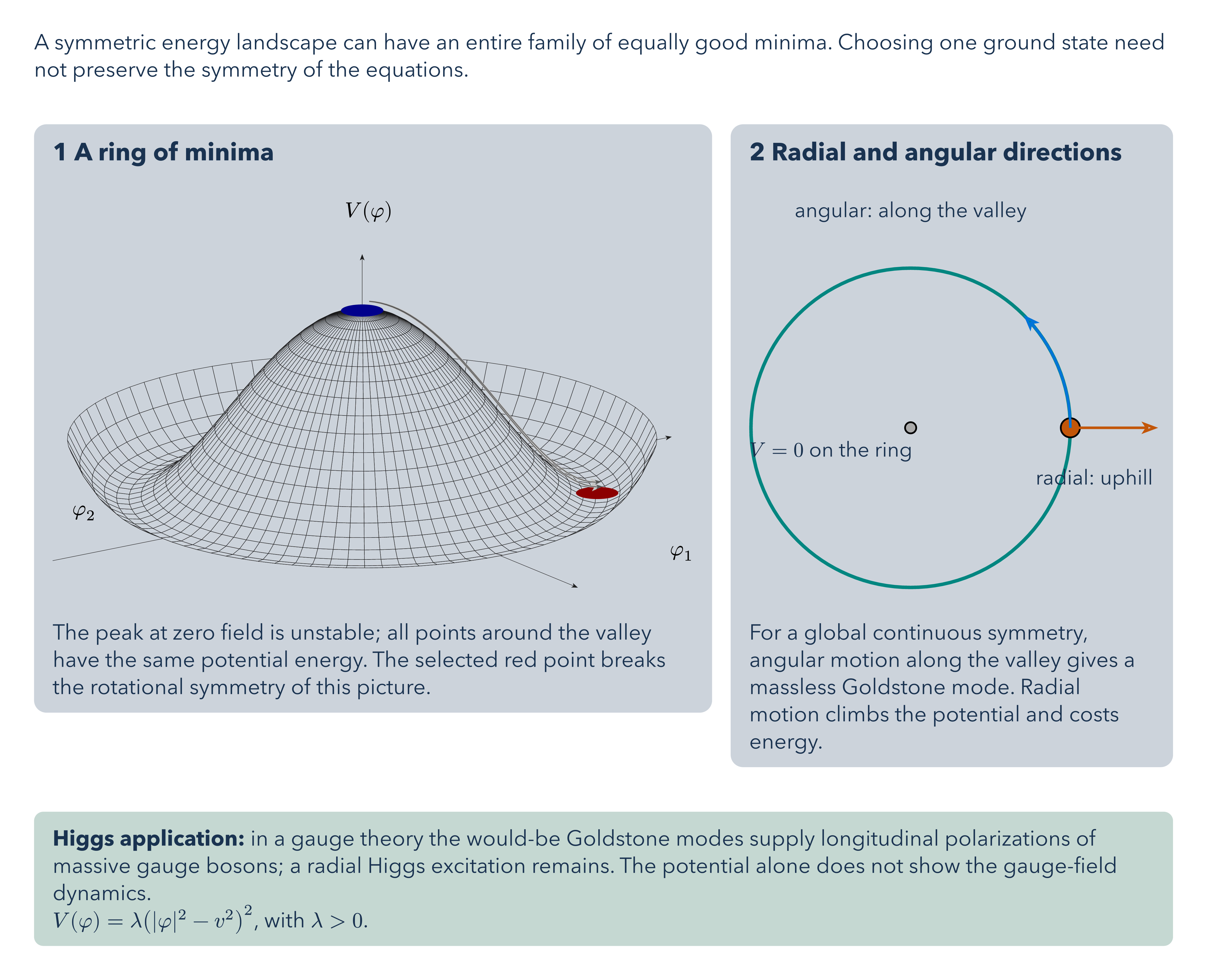
A symmetric energy landscape can have an entire family of equally good minima. Choosing one ground state need not preserve the symmetry of the equations.
Download
Code
symmetry-breaking.typ (224 lines)
#import "@preview/cetz:0.5.2": canvas, draw, matrix
#import draw: circle, content, line, on-layer, rotate, scale, set-style, set-transform, translate
#let label-size = 12pt
#let paragraph-size = 14pt
#let heading-size = 16pt

#let card_body(title, body, caption) = block(
  width: 100%,
  inset: 12pt,
  radius: 8pt,
  fill: rgb("#cdd3da"),
  breakable: false,
)[
  #text(size: heading-size, weight: "bold", title)
  #v(8pt)
  // Measure unconstrained artwork before scaling, including content wider than its card.
  #layout(size => {
    let artwork = text(size: label-size, body)
    std.scale(size.width / measure(artwork).width * 100%, reflow: true, artwork)
  })
  #v(7pt)
  #text(size: paragraph-size, caption)
]

#let card-grid(columns: 2, ..cards) = layout(size => {
  let rows = cards
    .pos()
    .chunks(columns)
    .map(row => {
      let ratios = row.map(card => {
        let bounds = measure(text(size: label-size, card.at(1)))
        bounds.width / bounds.height
      })
      let available = size.width - 12pt * (row.len() - 1) - 24pt * row.len()
      grid(
        columns: ratios.map(ratio => 24pt + available * ratio / ratios.sum()),
        gutter: 12pt,
        ..row.map(args => card_body(..args)),
      )
    })
  stack(dir: ttb, spacing: 12pt, ..rows)
})

#let takeaway(body) = block(
  width: 100%,
  inset: 12pt,
  radius: 6pt,
  fill: rgb("#c6d8d2"),
  breakable: false,
  text(size: paragraph-size, body),
)

#set page(width: 780pt, height: auto, margin: 22pt, fill: none)
#set text(font: "Avenir Next", size: paragraph-size, fill: rgb("#19324f"))
#set par(leading: 0.55em)

// === 1  A ring of minima ===
#let figure-0 = [
  #set text(fill: black)

  #let radius-domain = (0.0, 1.25)
  #let angle-steps = 84
  #let radius-steps = 24
  #let x-limits = (-1.6, 1.6)
  #let y-limits = (-1.6, 1.6)
  #let z-limits = (0.0, 1.3)

  #let mexican-hat-height(radius-val) = {
    calc.pow(radius-val * radius-val - 1.0, 2)
  }

  #let surface-point(radius-val, theta-deg) = {
    let theta = theta-deg * 1deg
    (
      calc.sin(theta) * radius-val,
      calc.cos(theta) * radius-val,
      mexican-hat-height(radius-val),
    )
  }

  #canvas(length: 1.55cm, {
    set-transform(matrix.transform-rotate-dir((2.5, 0.6, -2), (0, 1, 0.3)))
    // z must scale positive: negating it turns the hat's central bump into a pit, which
    // puts the symmetric vacuum below the broken one and points the downhill arrow uphill
    scale(x: 3, y: 3, z: 2.5)
    rotate(z: -5deg)
    translate((0, -0.02, 0))

    // Surface mesh, drawn first.
    let (radius-min, radius-max) = radius-domain
    let radius-step = (radius-max - radius-min) / radius-steps
    let angle-step = 360.0 / angle-steps
    set-style(stroke: rgb("#1a1a1a") + 0.22pt, fill: rgb("#cdd3da"))
    for radius-rev-idx in range(radius-steps) {
      let radius-idx = radius-steps - 1 - radius-rev-idx
      let radius-inner = radius-min + radius-idx * radius-step
      let radius-outer = radius-inner + radius-step
      for angle-idx in range(angle-steps) {
        let theta-left = angle-idx * angle-step
        let theta-right = theta-left + angle-step

        line(
          surface-point(radius-inner, theta-left),
          surface-point(radius-inner, theta-right),
          surface-point(radius-outer, theta-right),
          surface-point(radius-outer, theta-left),
          close: true,
        )
      }
    }
    let apex-point = surface-point(0.0, 0.0)
    let first-ring-radius = radius-step
    for angle-idx in range(angle-steps) {
      let theta-left = angle-idx * angle-step
      let theta-right = theta-left + angle-step
      line(
        apex-point,
        surface-point(first-ring-radius, theta-left),
        surface-point(first-ring-radius, theta-right),
        close: true,
      )
    }
    // Axis lines centered at the origin.
    let (x-min, x-max) = x-limits
    let (y-min, y-max) = y-limits
    let (z-min, z-max) = z-limits
    on-layer(-2, {
      set-style(stroke: rgb("#1f1f1f") + 0.22pt, mark: (
        fill: rgb("#1f1f1f"),
        stroke: rgb("#1f1f1f"),
        scale: 0.52,
        end: "stealth",
      ))
      line((x-min, 0, 0), (x-max, 0, 0))
      line((0, y-min, 0), (0, y-max, 0))
      line((0, 0, z-min), (0, 0, z-max))
    })

    on-layer(8, {
      set-style(fill: black)
      content((1.42, 0.6, 0.02), [$phi_1$], anchor: "west")
      content((-0.7, -0.95, -0.02), [$phi_2$], anchor: "north")
      content((0.02, 0.02, 1.47), [$V(phi)$], anchor: "south")
    })

    // Highlighted states.
    let center-point = surface-point(0.0, 0.0)
    let minimum-point = surface-point(1.0, 30.0)
    circle(center-point, radius: 0.09, fill: rgb("#00008b"), stroke: none)
    circle(minimum-point, radius: 0.09, fill: rgb("#8b0000"), stroke: none)

    // Double downhill arrow that follows the surface profile.
    let arrow-color = rgb("#c4c4c4")
    let arrow-steps = 40
    let arrow-radius-start = 0.03
    let arrow-radius-stop = 1.02
    let arrow-clearance = 0.05
    let downhill-point(radius-val, theta-deg) = {
      let (coord_x, coord_y, height) = surface-point(radius-val, theta-deg)
      (coord_x, coord_y, height + arrow-clearance)
    }
    on-layer(9, {
      // sample the surface profile at a fixed bearing, lifted clear of the mesh
      let downhill-arrow(theta-deg) = line(
        ..range(arrow-steps + 1).map(step => {
          let t = step / arrow-steps
          let span = arrow-radius-stop - arrow-radius-start
          downhill-point(arrow-radius-start + t * span, theta-deg)
        }),
      )

      // stroked twice: a thick pale body, then a thin dark core to crisp the edges
      for (paint, thickness, scale) in (
        (arrow-color, 1.1pt, 0.56),
        (rgb("#575757"), 0.42pt, 0.44),
      ) {
        set-style(
          stroke: (paint: paint, thickness: thickness),
          fill: none,
          mark: (fill: paint, stroke: paint, scale: scale, end: "stealth"),
        )
        for theta in (28.8, 32.8) { downhill-arrow(theta) }
      }
    })
  })
]

// === 2  Radial and angular directions ===
#let figure-1 = canvas(length: 1.63cm, {
  draw.circle((0, 0), radius: 2, stroke: rgb("#008580") + 2pt)
  draw.circle((0, 0), radius: .07, fill: gray)
  draw.circle((2, 0), radius: .12, fill: rgb("#c2570a"))
  draw.line((2, 0), (3.1, 0), stroke: rgb("#c2570a") + 1.5pt, mark: (end: "stealth"))
  draw.arc(
    (0, 0),
    radius: 2,
    start: 0deg,
    stop: 45deg,
    anchor: "origin",
    stroke: blue + 1.5pt,
    mark: (end: "stealth"),
  )
  draw.content((2.3, -.65), [radial: uphill])
  draw.content((0, 2.7), [angular: along the valley])
  draw.content((-1, -.3), [$V=0$ on the ring])
})

A symmetric energy landscape can have an entire family of equally good minima. Choosing one ground state need not preserve the symmetry of the equations.
#v(14pt)
#card-grid(
  (
    [1  A ring of minima],
    figure-0,
    [The peak at zero field is unstable; all points around the valley have the same potential energy. The selected red point breaks the rotational symmetry of this picture.],
  ),
  (
    [2  Radial and angular directions],
    figure-1,
    [For a global continuous symmetry, angular motion along the valley gives a massless Goldstone mode. Radial motion climbs the potential and costs energy.],
  ),
)
#v(12pt)
#takeaway[*Higgs application:* in a gauge theory the would-be Goldstone modes supply longitudinal polarizations of massive gauge bosons; a radial Higgs excitation remains. The potential alone does not show the gauge-field dynamics.\ $V(phi)=lambda (abs(phi)^2-v^2)^2$, with $lambda>0$.]