Burrows-Wheeler Transform
Creator: Petar Veličković (original)
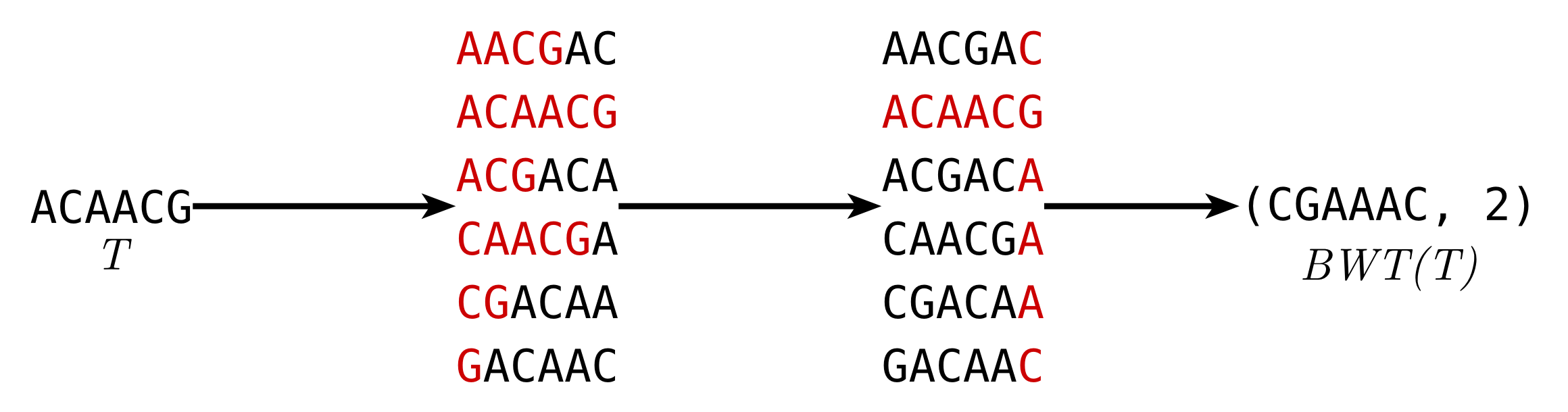
The Burrows-Wheeler transform lists all cyclic rotations of a string, sorts them lexicographically, and reads off the last column together with the row index of the original string. In the first table, red marks the suffix of that starts each sorted rotation; in the second, red marks the last column and the row holding itself (row 2).
Download
Code
#import "@preview/cetz:0.5.3": canvas, draw
#import draw: content, line

#set page(width: auto, height: auto, margin: 8pt, fill: none)
#set text(size: 12pt, font: "DejaVu Sans Mono")

#let t-str = "ACAACG"
#let n-chars = t-str.len()
// cyclic rotations tagged with their shift, in lexicographic order
#let rotations = (
  range(n-chars).map(shift => (t-str.slice(shift) + t-str.slice(0, shift), shift)).sorted()
)

#let red-txt(s) = text(fill: rgb("#cc0000"), s)
#let column(rows) = align(left, rows.join(linebreak()))

// first table highlights the suffix of T starting each sorted rotation, second the last column
#let suffix-col = column(rotations.map(((rot, shift)) => {
  [#red-txt(rot.slice(0, n-chars - shift))#rot.slice(n-chars - shift)]
}))
#let last-col = column(rotations.map(((rot, shift)) => {
  if shift == 0 { red-txt(rot) } else [#rot.slice(0, -1)#red-txt(rot.slice(-1))]
}))

#let bwt-str = rotations.map(((rot, _)) => rot.last()).join()
#let orig-row = rotations.position(((_, shift)) => shift == 0) + 1

#let serif-italic(body) = text(font: "New Computer Modern", style: "italic", body)

#canvas({
  let arrow = (mark: (end: "stealth", fill: black, scale: .85), stroke: black + 1.6pt)
  content((0, 0), t-str, name: "T")
  content((rel: (0, -.45), to: "T"), serif-italic[T])

  // each stage sits a fixed step right of the previous one
  content((rel: (4, 0), to: "T"), suffix-col, name: "rot")
  content((rel: (4, 0), to: "rot"), last-col, name: "sort")
  content((rel: (4, 0), to: "sort"), [(#bwt-str, #orig-row)], name: "bwt")
  content((rel: (0, -.6), to: "bwt"), serif-italic[BWT(T)])

  for (from, to) in (("T", "rot"), ("rot", "sort"), ("sort", "bwt")) {
    line(from, to, ..arrow)
  }
})