Curved Spacetime Embedding
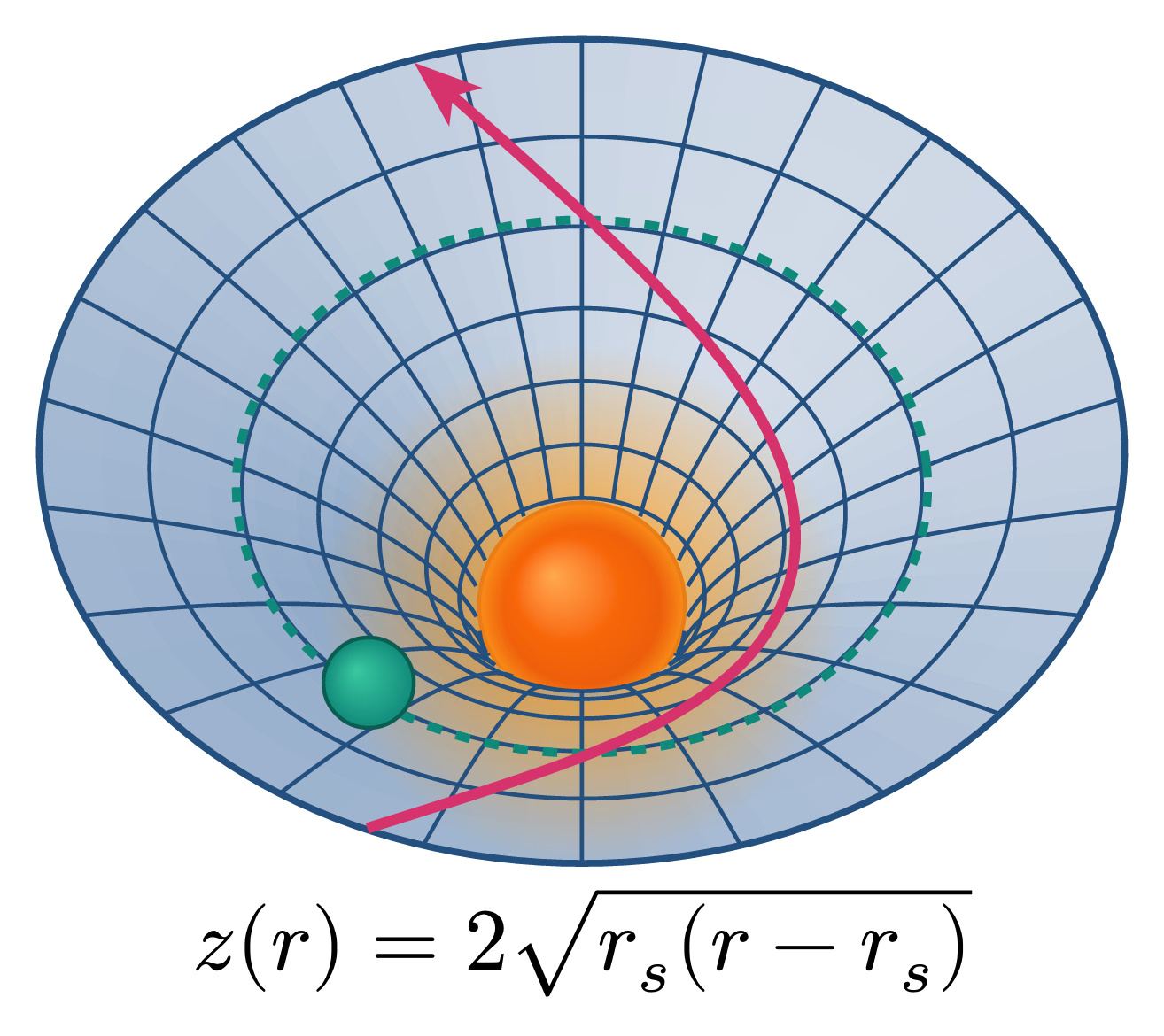
Flamm's paraboloid embeds the equatorial plane of the Schwarzschild geometry in flat 3D space, so radial distances along the funnel are the true proper distances, which stretch as the throat at the Schwarzschild radius is approached. A planet follows a stable circular orbit at , outside the innermost stable circular orbit at , while a light ray with periapsis , computed from the null geodesic equation with , is bent around the mass.
Download
Code
curved-spacetime-embedding.typ (201 lines)
#import "@preview/cetz:0.5.2": canvas, draw
#import draw: circle, content, line

#set page(width: auto, height: auto, margin: 8pt, fill: none)
#set text(size: 18pt)

// Flamm's paraboloid: the equatorial plane of the Schwarzschild metric embedded in flat 3D
// space has height z(r) = 2 sqrt(r_s (r - r_s)). All lengths are in units of r_s.
#let r-max = 5.0
#let height(r) = 2 * calc.sqrt(calc.max(r - 1, 0))
#let slope(r) = 1 / calc.sqrt(calc.max(r - 1, 1e-6)) // dz/dr
#let z-top = height(r-max)
#let r-of-z(z) = 1 + z * z / 4 // inverse of height(r)
#let r-orbit = 3.3 // outside the ISCO at 3 r_s, so a stable circular orbit
#let r-peri = 2.1 // periapsis of the light ray (photon sphere at 1.5 r_s)
#assert(r-peri > 1.5, message: "rays with periapsis inside the photon sphere are captured")

#let wire-color = rgb("#24507f")
#let ring-color = rgb("#0f8a7a")
#let ray-color = rgb("#d6336c")

// === perspective camera looking down into the well ===
#let elev = 52deg
#let cam-dist = 26.0
#let z-aim = z-top * 0.45
#let (ce, se) = (calc.cos(elev), calc.sin(elev))
#let cam = (0.0, -cam-dist * ce, z-aim + cam-dist * se)
#let view-depth((x, y, z)) = y * ce - (z - z-aim) * se
#let project((x, y, z)) = {
  let s = cam-dist / (cam-dist + view-depth((x, y, z)))
  (x * s, (y * se + (z - z-aim) * ce) * s)
}
#let surf(r, phi, lift: 0) = (r * calc.cos(phi), r * calc.sin(phi), height(r) + lift)
#let normal(r, phi) = {
  let (m, c, s) = (slope(r), calc.cos(phi), calc.sin(phi))
  let len = calc.sqrt(1 + m * m)
  (-m * c / len, -m * s / len, 1 / len)
}
#let dot(a, b) = a.zip(b).map(((p, q)) => p * q).sum()
#let sub(a, b) = a.zip(b).map(((p, q)) => p - q)

// The mass sits in the throat; it doubles as an occluder in the visibility test.
#let star-pos = (0.0, 0.0, 0.8)
#let star-rad = 1.08

// March from a point towards the camera; it is hidden if the ray pierces the surface
// (changes sides) or the star before rising above the rim.
#let visible(p, above: true) = {
  let d = sub(cam, p)
  let u = d.map(c => c / calc.norm(..d))
  let t = 0.06
  while true {
    let q = p.zip(u).map(((a, b)) => a + t * b)
    let (qx, qy, qz) = q
    if qz > z-top + 0.01 { return true }
    let rq = calc.sqrt(qx * qx + qy * qy)
    if rq >= 1 and rq <= r-max {
      let gap = qz - height(rq)
      if (above and gap < -0.005) or (not above and gap > 0.005) { return false }
    }
    let to-star = sub(q, star-pos)
    if dot(to-star, to-star) < star-rad * star-rad { return false }
    t += 0.07
  }
}
#let faces-camera(r, phi) = {
  let p = surf(r, phi)
  dot(normal(r, phi), sub(cam, p)) > 0
}

// Split a 3D polyline, given as (point, front-facing) pairs, into its visible projected runs.
#let visible-runs(samples) = {
  let (runs, run) = ((), ())
  for (p, above) in samples {
    if visible(p, above: above) { run.push(project(p)) } else {
      if run.len() > 1 { runs.push(run) }
      run = ()
    }
  }
  if run.len() > 1 { runs.push(run) }
  runs
}
#let draw-visible(samples, style) = for run in visible-runs(samples) { line(..run, ..style) }
// a surface point lifted slightly off the surface, with whether its upper side faces the camera
#let sample(r, phi, lift: 0.01) = (surf(r, phi, lift: lift), faces-camera(r, phi))
#let ring(r, n, lift: 0.01) = range(n + 1).map(i => sample(r, i * 2 * calc.pi / n, lift: lift))

// Light ray in the equatorial plane: u'' + u = (3/2) r_s u^2 with u = 1/r, RK4 in phi.
#let ray-points = {
  let b = r-peri / calc.sqrt(1 - 1 / r-peri)
  let accel(u) = -u + 1.5 * u * u
  let (u, w, phi, h) = (1 / 40, 0.0, 0.0, 0.01)
  w = calc.sqrt(1 / (b * b) - u * u + u * u * u)
  let pts = ()
  let phi-peri = none
  while u > 1 / 41 or phi-peri == none {
    let (k1u, k1w) = (w, accel(u))
    let (k2u, k2w) = (w + h / 2 * k1w, accel(u + h / 2 * k1u))
    let (k3u, k3w) = (w + h / 2 * k2w, accel(u + h / 2 * k2u))
    let (k4u, k4w) = (w + h * k3w, accel(u + h * k3u))
    let w-new = w + h / 6 * (k1w + 2 * k2w + 2 * k3w + k4w)
    u += h / 6 * (k1u + 2 * k2u + 2 * k3u + k4u)
    if phi-peri == none and w-new < 0 { phi-peri = phi }
    w = w-new
    phi += h
    if 1 / u <= r-max { pts.push((1 / u, phi)) }
  }
  // rotate the periapsis to phi = 0 (+x), so the ray swings around the right of the throat
  pts.map(((r, phi)) => (r, phi - phi-peri))
}

#canvas(length: 0.72cm, {
  let n-z = 15
  let n-phi = 60
  let light = (-0.45, -0.55, 0.7).map(c => c / calc.norm(-0.45, -0.55, 0.7))

  // shaded surface patches plus the star as (depth, element), painted back to front
  let star-c = project(star-pos)
  let items = ()
  for k in range(n-z) {
    let (r0, r1) = (r-of-z(k * z-top / n-z), r-of-z((k + 1) * z-top / n-z))
    for ip in range(n-phi) {
      let (p0, p1) = (ip * 2 * calc.pi / n-phi, (ip + 1) * 2 * calc.pi / n-phi)
      let corners = ((r0, p0), (r1, p0), (r1, p1), (r0, p1)).map(((r, p)) => surf(r, p))
      let (rm, pm) = ((r0 + r1) / 2, (p0 + p1) / 2)
      let n = normal(rm, pm)
      let front = faces-camera(rm, pm)
      // the inner face is lit from the light; the outer face is in shadow
      let lit = if front { 0.35 + 0.65 * calc.max(0, dot(n, light)) } else { 0.15 }
      let fill = color.mix((rgb("#5f84b0"), 100% - lit * 100%), (rgb("#d3dce8"), lit * 100%))
      let pts = corners.map(project)
      items.push((
        corners.map(view-depth).sum() / 4,
        line(..pts, close: true, fill: fill, stroke: fill + 0.4pt),
      ))
    }
  }
  items.push((
    view-depth(star-pos),
    circle(star-c, radius: star-rad * 0.95, stroke: rgb("#c2410c") + 0.8pt, fill: gradient.radial(
      // narrow lightness range so the star still reads as glowing once inverted
      rgb("#ffa94d"),
      rgb("#f76707"),
      rgb("#e8590c"),
      focal-center: (35%, 35%),
    )),
  ))
  for (_, element) in items.sorted(key: it => -it.at(0)) { element }

  // warm glow of the star on the surrounding surface, clear over the star itself
  circle(star-c, radius: 2.6, stroke: none, fill: gradient.radial(
    (rgb("#ff9f1c").transparentize(100%), 0%),
    (rgb("#ff9f1c").transparentize(100%), 30%),
    (rgb("#ff9f1c").transparentize(35%), 38%),
    (rgb("#ff9f1c").transparentize(100%), 100%),
  ))

  // wireframe: rings evenly spaced in height and radial lines every 15 deg
  let wire = (stroke: wire-color + 0.85pt)
  for k in range(1, 9) {
    draw-visible(ring(r-of-z(k * z-top / 8), 180), if k == 8 {
      (stroke: wire-color + 1.4pt)
    } else { wire })
  }
  for ip in range(24) {
    let phi = ip * 2 * calc.pi / 24
    draw-visible(range(0, 61).map(i => sample(r-of-z(i * z-top / 60), phi)), wire)
  }
  // throat circle r = r_s
  draw-visible(ring(1.0, 180).map(((p, _)) => (p, true)), (stroke: wire-color + 1.4pt))

  // planetary orbit
  draw-visible(ring(r-orbit, 240, lift: 0.02), (
    stroke: (paint: ring-color, thickness: 1.8pt, dash: "dashed"),
  ))

  // bent light ray, traveling from the near rim around the mass to the far rim
  let ray-runs = visible-runs(
    ray-points.map(((r, phi)) => sample(r, phi, lift: 0.03)),
  )
  for (idx, run) in ray-runs.enumerate() {
    let last = idx == ray-runs.len() - 1
    line(..run, stroke: ray-color + 2.2pt, mark: if last {
      (end: "stealth", fill: ray-color, scale: 1.4)
    })
  }

  // planet
  let planet-phi = -125deg / 1rad
  let planet = project(surf(r-orbit, planet-phi, lift: 0.25))
  circle(planet, radius: 0.45, stroke: rgb("#0b5d52") + 0.8pt, fill: gradient.radial(
    rgb("#38c9a0"),
    rgb("#0f8a7a"),
    focal-center: (35%, 35%),
  ))

  // embedding height below the funnel
  let bottom = project(surf(r-max, -90deg / 1rad)).at(1)
  content((0, bottom - 0.45), $z(r) = 2 sqrt(r_s (r - r_s))$, anchor: "north")
})