Generative Adversarial Network
Creator: Petar Veličković (original)
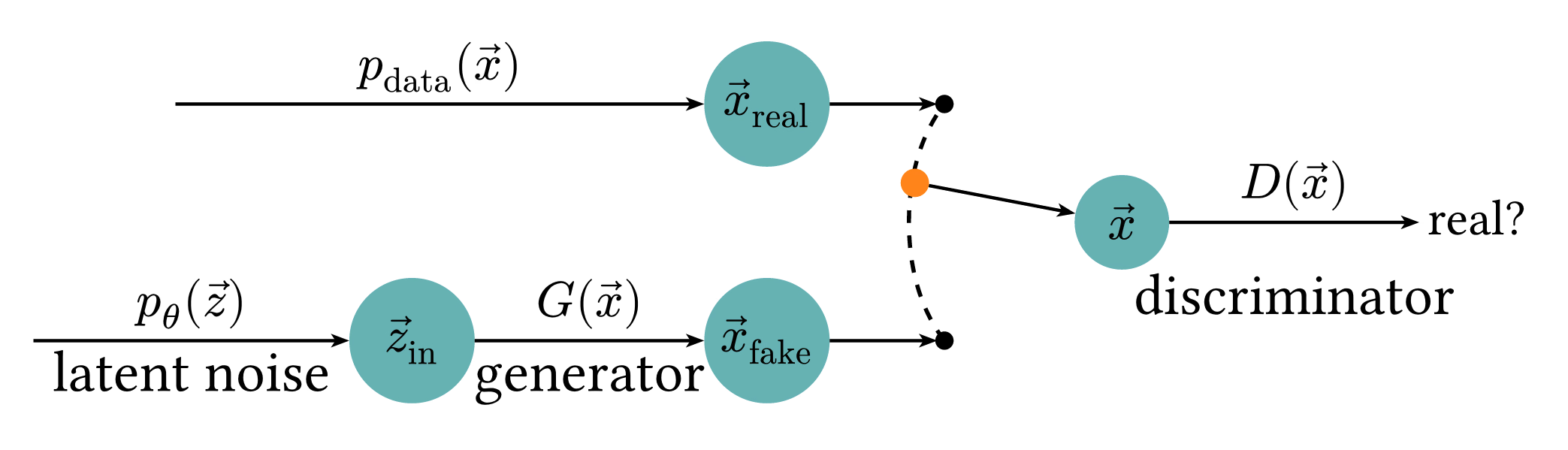
Generative adversarial network (GAN) architecture. A GAN has two parts. The discriminator acts as a classifier that learns to distinguish fake data produced by the generator from real data. incurs a penalty when detects implausible results. This signal is backpropagated through the generator weights such that learns to produce more realistic samples over time, eventually fooling the discriminator if training succeeds.
Download
Code
generative-adversarial-network.typ (89 lines)
#import "@preview/cetz:0.5.2": canvas, draw
#import draw: circle, content, hobby, line, on-layer

#set page(width: auto, height: auto, margin: 8pt, fill: none)
#set text(size: 12pt)

#canvas({
  // Style definitions
  let node-style = (
    stroke: none,
    fill: rgb("#66B2B2"), // teal!60 equivalent
    radius: 0.53,
  )
  let arrow-style = (
    stroke: 0.8pt,
    mark: (end: "stealth", scale: 0.4, fill: black),
  )
  let annotated-arrow(start, end, name, formula, caption: none, caption-padding: 0.1) = {
    line(start, end, ..arrow-style, name: name)
    content(name + ".mid", formula, anchor: "south", padding: 0.1)
    if caption != none {
      content(
        name + ".mid",
        text(size: 14pt, caption),
        anchor: "north",
        padding: caption-padding,
      )
    }
  }

  let (y-real, y-fake) = (2, 0)

  for (pos, name, label, radius) in (
    ((0, y-fake), "zin", $arrow(z)_"in"$, 0.53),
    ((3, y-fake), "fake", $arrow(x)_"fake"$, 0.53),
    ((3, y-real), "real", $arrow(x)_"real"$, 0.53),
    ((6, y-real / 2), "D", $arrow(x)$, 0.4),
  ) {
    circle(pos, name: name, ..node-style, radius: radius)
    content(name, label)
  }

  // Output node
  content(
    (9, y-real / 2),
    text(size: 12pt, baseline: -1pt)[real?],
    name: "out",
    padding: 2pt,
  )

  annotated-arrow((-3.2, y-fake), "zin", "zin-line", $p_theta (arrow(z))$, caption: [latent noise])
  annotated-arrow("zin", "fake", "fake-line", $G(arrow(x))$, caption: [generator])
  annotated-arrow((-2, y-real), "real", "real-line", $p_"data" (arrow(x))$)

  // Connection points with names
  for (idx, y) in ((1, y-fake), (2, y-real)) {
    circle((4.5, y), radius: 0.06, fill: black, name: "dot" + str(idx))
  }
  on-layer(1, circle(
    (4.25, 2 * y-real / 3),
    radius: 0.12,
    fill: orange,
    stroke: none,
    name: "dot3",
  ))

  for (idx, start, end) in ((1, "fake", "dot1"), (2, "real", "dot2"), (3, "dot3", "D")) {
    line(start, end, ..arrow-style, name: "conn" + str(idx))
  }

  hobby(
    "dot1",
    (4.2, (y-real - y-fake) / 2),
    "dot2",
    stroke: (dash: "dashed"),
    omega: 2,
    name: "dashed-curve",
  )

  annotated-arrow(
    "D",
    "out",
    "disc-line",
    $D(arrow(x))$,
    caption: [discriminator],
    caption-padding: 0.45,
  )
})