Particle vs String Interactions
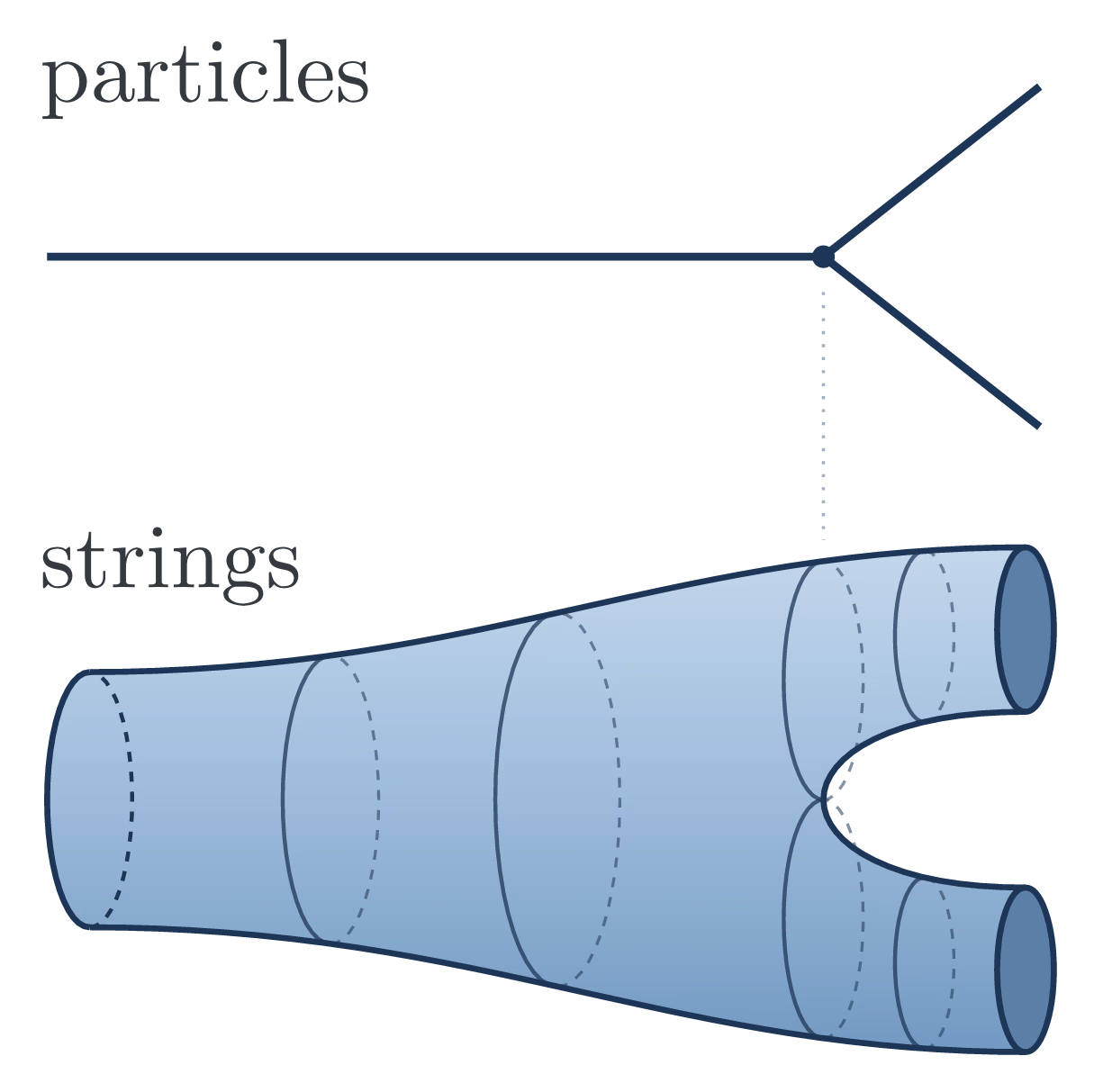
In quantum field theory, particles interact at points: at a cubic vertex one worldline splits into two at a sharp, singular spacetime point, the source of ultraviolet divergences in loop diagrams. In string theory, the same process is a closed string splitting into two, sweeping out a smooth "pair of pants" worldsheet (loops show the string at successive times, pinching into a figure-eight as it splits) with no distinguished interaction point, since observers in different Lorentz frames disagree on where the split happens. The interaction is encoded in the worldsheet topology, with each splitting weighted by the string coupling .
Download
Code
#import "@preview/cetz:0.5.3": canvas, draw
#import draw: bezier, circle, content, line, merge-path

#set page(width: auto, height: auto, margin: 8pt, fill: none)
#set text(size: 18pt, font: "New Computer Modern", fill: rgb("#343a40"))

#let ink = rgb("#1d3557")
#let interior = rgb("#5b7fa6")
// lit from above: light upper tube, darker lower tube
#let surface = gradient.linear(rgb("#c3d7ec"), rgb("#9dbbdb"), rgb("#7299c2"), angle: 90deg)

// geometry: length of the diagram, end-tube radii and offsets of the outgoing tubes
#let len = 6.6
#let (rx0, ry0) = (.3, .9) // incoming tube rim (projected ellipse)
#let (rx1, ry1) = (.2, .58) // outgoing tube rims
#let spread = 1.2 // vertical offset of the outgoing tubes
#let crotch-depth = 1.9 // how far the inner U reaches back from the outgoing rims

#let outer-top = ((0, ry0), (len * .42, ry0), (len * .62, spread + ry1), (len, spread + ry1))
#let outer-bot = outer-top.map(((x, y)) => (x, -y))
#let crotch = (
  (len, spread - ry1),
  (len - crotch-depth, spread - ry1),
  (len - crotch-depth, -spread + ry1),
  (len, -spread + ry1),
)
#let x-pinch = len - .75 * crotch-depth // leftmost point of the crotch, where the string splits

// cubic bezier through control points (start, c1, c2, end), and its point at parameter t
#let curve(pts, ..style) = bezier(pts.at(0), pts.at(3), pts.at(1), pts.at(2), ..style)
#let bez-at(pts, t) = {
  let (p0, p1, p2, p3) = pts
  let u = 1 - t
  range(2).map(k => (
    u * u * u * p0.at(k)
      + 3 * u * u * t * p1.at(k)
      + 3 * u * t * t * p2.at(k)
      + t * t * t * p3.at(k)
  ))
}
// height of a curve at x by bisection over t in [lo, hi], along which x increases or decreases
#let y-at(pts, x, lo: 0.0, hi: 1.0) = {
  let rising = bez-at(pts, hi).at(0) > bez-at(pts, lo).at(0)
  for _ in range(40) {
    let mid = (lo + hi) / 2
    if (bez-at(pts, mid).at(0) < x) == rising { lo = mid } else { hi = mid }
  }
  bez-at(pts, lo).at(1)
}

// points on an axis-aligned ellipse from angle a to b (degrees)
#let ellipse-pts(center, rx, ry, a, b, n: 24) = range(n + 1).map(i => {
  let t = (a + (b - a) * i / n) * 1deg
  (center.at(0) + rx * calc.cos(t), center.at(1) + ry * calc.sin(t))
})
// a loop of string on the worldsheet: near (left) half solid, far half dashed
#let slice(center, ry, rx-per-ry: rx0 / ry0) = {
  let rx = ry * rx-per-ry
  line(..ellipse-pts(center, rx, ry, 90, 270), stroke: ink.transparentize(25%) + .8pt)
  line(..ellipse-pts(center, rx, ry, -90, 90), stroke: (
    paint: ink.transparentize(45%),
    thickness: .6pt,
    dash: (2pt, 2pt),
  ))
}

#canvas(length: 1cm, {
  // ---------- strings: pair of pants, viewed slightly from the right ----------
  let (top, bot) = ((len, spread), (len, -spread))

  // tube interiors seen through the outgoing openings
  for c in (top, bot) { circle(c, radius: (rx1, ry1), fill: interior, stroke: none) }

  // outer surface: near (left) halves of every rim bound it
  merge-path(fill: surface, stroke: none, close: true, {
    line(..ellipse-pts((0, 0), rx0, ry0, -90, -270))
    curve(outer-top)
    line(..ellipse-pts(top, rx1, ry1, 90, 270))
    curve(crotch)
    line(..ellipse-pts(bot, rx1, ry1, 90, 270))
    curve(outer-bot.rev())
  })

  // the string at successive times: one loop, a figure-eight at the split, then two loops
  for x in (1.7, 3.3) { slice((x, 0), y-at(outer-top, x)) }
  let h-pinch = y-at(outer-top, x-pinch) / 2
  for y in (h-pinch, -h-pinch) { slice((x-pinch, y), h-pinch) }
  let x-two = (x-pinch + len) / 2
  let (y-out, y-in) = (y-at(outer-top, x-two), y-at(crotch, x-two, hi: .5))
  for sign in (1, -1) {
    slice((x-two, sign * (y-out + y-in) / 2), (y-out - y-in) / 2, rx-per-ry: rx1 / ry1)
  }

  // outlines
  let edge = ink + 1.2pt
  for pts in (outer-top, outer-bot, crotch) { curve(pts, stroke: edge) }
  line(..ellipse-pts((0, 0), rx0, ry0, 90, 270), stroke: edge)
  line(..ellipse-pts((0, 0), rx0, ry0, -90, 90), stroke: (
    paint: ink,
    thickness: .8pt,
    dash: (2pt, 2pt),
  ))
  for c in (top, bot) { circle(c, radius: (rx1, ry1), stroke: edge) } // we look into the openings

  content((-.35, spread + .45), [strings], anchor: "west")

  // ---------- particles: cubic vertex, aligned with the string's split ----------
  let y0 = 2 * spread + ry1 + .85 // vertical position of the particle panel
  let v = (x-pinch, y0)
  line((x-pinch, y0 - .25), (x-pinch, y-at(outer-top, x-pinch) + .15), stroke: (
    paint: ink.transparentize(60%),
    thickness: .6pt,
    dash: "dotted",
  ))
  line((-.3, y0), v, stroke: ink + 1.6pt)
  for dy in (spread, -spread) { line(v, (len + .1, y0 + dy), stroke: ink + 1.6pt) }
  circle(v, radius: .08, fill: ink, stroke: none)

  content((-.35, y0 + spread + .05), [particles], anchor: "west")
})