Thermodynamic Potentials Venn Diagram
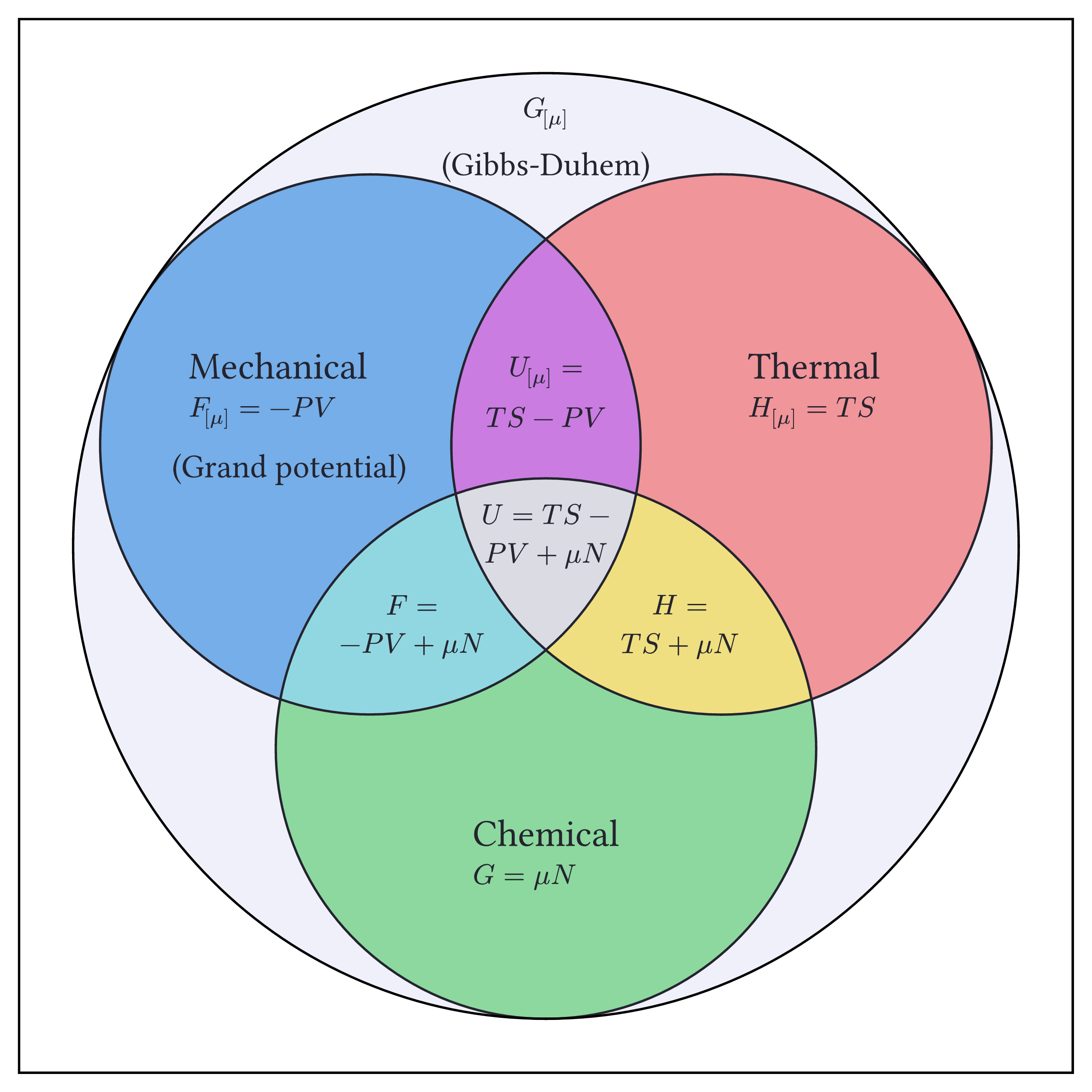
A Venn diagram illustrating the relationships between thermodynamic potentials, forces, and flows. The diagram shows three main regions (Mechanical, Thermal, Chemical) and their intersections, representing different thermodynamic potentials. The subscript μ denotes an N-to-μ Legendre transform of the indicated potential (U, H, F, or G). The diagram helps visualize how different thermodynamic quantities are related through Legendre transforms.
Download
Code
thermodynamic-potentials-venn-diagram.typ (106 lines)
#import "@preview/cetz:0.5.2": canvas, draw
#import draw: arc-through, circle, content, merge-path, rect, rotate, scale, scope

#set page(width: auto, height: auto, margin: 8pt, fill: none)
#set text(size: 12pt)

#canvas({
  // Scale up the diagram
  scale(4)

  let mechanical-center = (-0.65, 0.375)
  let thermal-center = (0.65, 0.375)
  let chemical-center = (0, -0.75)

  let ab-outer = (0, 1.135)
  let ab-inner = (0, -0.385)
  let ac-outer = (-0.983, -0.568)
  let ac-inner = (0.334, 0.193)
  let bc-inner = (-0.334, 0.193)

  let fills = (
    a: blue.transparentize(40%), // Mechanical (blue)
    b: red.transparentize(40%), // Thermal (red)
    c: green.transparentize(40%), // Chemical (green)
    ab: purple.transparentize(40%), // Overlap
    bc: yellow.transparentize(40%), // Overlap
    ac: teal.transparentize(40%), // Overlap
    abc: gray.transparentize(70%), // Center
  )

  rect((-1.95, 1.95), (1.95, -1.95), fill: none, stroke: auto)

  for (region, angle) in (("ab", 0deg), ("ac", 120deg), ("bc", 240deg)) {
    scope({
      rotate(angle)
      merge-path(
        {
          arc-through(bc-inner, (rel: (-1, 0), to: thermal-center), ab-outer)
          arc-through((), (rel: (+1, 0), to: mechanical-center), ac-inner)
          arc-through((), (rel: (0, +1), to: chemical-center), bc-inner)
        },
        fill: fills.at(region),
        stroke: none,
        close: true,
      )
    })
  }

  merge-path(
    {
      arc-through(
        ab-inner,
        (rel: (0.866, -0.5), to: mechanical-center),
        ac-inner,
      )
      arc-through((), (rel: (0, 1), to: chemical-center), bc-inner)
      arc-through((), (rel: (-0.866, -0.5), to: thermal-center), ab-inner)
    },
    fill: fills.abc,
    stroke: auto,
    close: true,
  )

  for (region, angle) in (("a", 0deg), ("c", 120deg), ("b", 240deg)) {
    scope({
      rotate(angle)
      merge-path(
        {
          arc-through(ab-outer, (rel: (-1, 0), to: mechanical-center), ac-outer)
          arc-through((), (rel: (-0.5, 0.866), to: chemical-center), bc-inner)
          arc-through((), (rel: (-1, 0), to: thermal-center), ab-outer)
        },
        fill: fills.at(region),
        stroke: auto,
        close: true,
      )
    })
  }

  for spec in (
    (
      pos: (-0.992, 0.573),
      body: [#text(size: 16pt)[Mechanical]\ $F_[mu] = -P V$],
      args: (anchor: "center"),
    ),
    (pos: (-0.95, 0.28), body: text(size: 14pt)[(Grand potential)], args: (anchor: "center")),
    (
      pos: (0.992, 0.573),
      body: [#text(size: 16pt)[Thermal]\ $H_[mu] = T S$],
      args: (anchor: "center"),
    ),
    (pos: (0, -1.146), body: [#text(size: 16pt)[Chemical]\ $G = mu N$], args: (anchor: "center")),
    (pos: (0, 0.523), body: align(center, $U_[mu] =\ T S - P V$), args: (anchor: "center")),
    (pos: (0, 0), body: text(12pt, align(center, $U = T S -\ P V + mu N$)), args: (:)),
    (pos: (-0.496, -0.336), body: align(center, $F =\ -P V + mu N$), args: (anchor: "center")),
    (pos: (0.496, -0.336), body: align(center, $H =\ T S + mu N$), args: (anchor: "center")),
    (pos: (0, 1.6), body: $G_[mu]$, args: (:)),
    (pos: (0, 1.4), body: text(size: 14pt)[(Gibbs-Duhem)], args: (:)),
  ) { content(spec.pos, spec.body, ..spec.args) }
  circle((0, 0), radius: 1.75, fill: rgb(70%, 70%, 90%, 20%), stroke: rgb(
    0%,
    0%,
    0%,
  ))
})