Timed Event Graph
Creator: Kreijstal
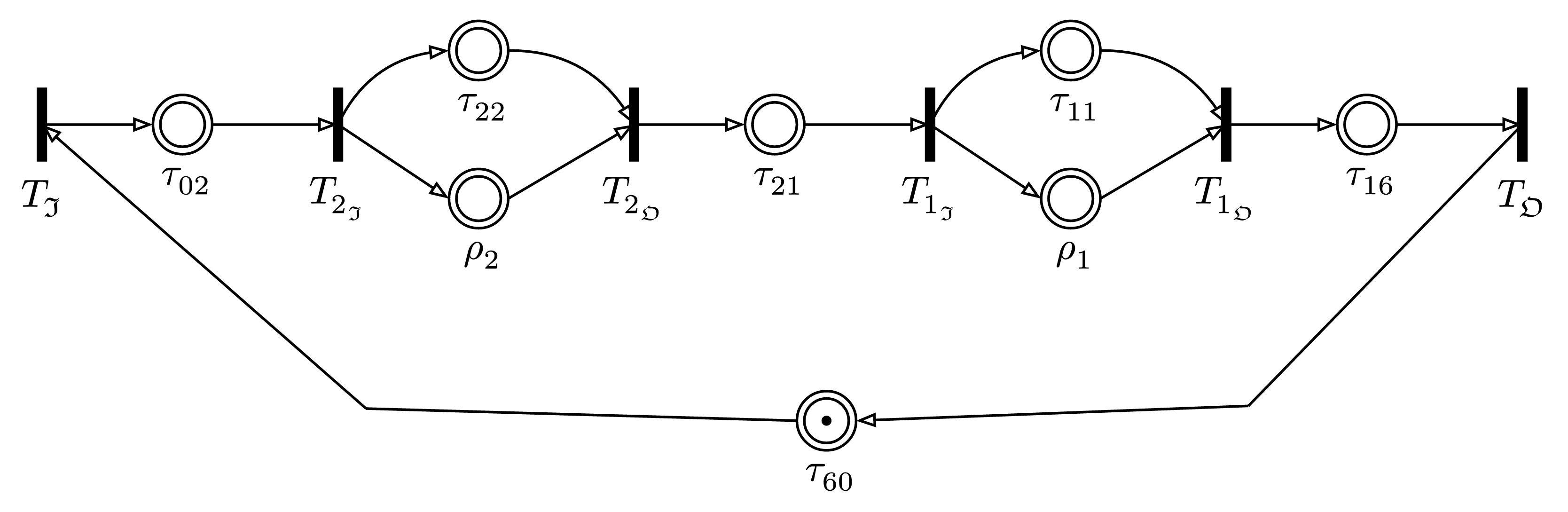
A representation of a Timed Event Graph, a specific type of Petri net. Uses custom functions to draw places (circles, potentially with tokens) and transitions (bars), connected by directed arcs to model processes or workflows with timing considerations.
Download
Code
timed-event-graph.typ (138 lines)
#import "@preview/cetz:0.5.2"

#set page(width: auto, height: auto, margin: 8pt, fill: none)
#set text(size: 12pt)

#let transition(coords, name: none, content: none, color: black) = {
  cetz.draw.group(name: name, {
    let top-pos = (rel: (0, 0.5), to: coords)
    let bottom-pos = (rel: (0, -0.5), to: coords)

    cetz.draw.line(top-pos, bottom-pos, stroke: (thickness: 4pt, paint: color))

    cetz.draw.anchor("default", coords)
    cetz.draw.anchor("center", coords)
    cetz.draw.anchor("left", coords)
    cetz.draw.anchor("right", coords)
    cetz.draw.anchor("top", top-pos)
    cetz.draw.anchor("bottom", bottom-pos)

    if content != none {
      cetz.draw.content((rel: (-0, -1.0), to: coords))[
        #set text(size: 15pt)
        #content
      ]
    }
  })
}

#let place(coords, name: none, content: none, token: false) = {
  cetz.draw.group(name: name, {
    let radius = 0.4

    cetz.draw.arc(coords, start: 0deg, stop: 360deg, radius: radius)

    cetz.draw.anchor("default", coords)
    cetz.draw.anchor("center", coords)
    cetz.draw.anchor("north", (rel: (0, radius), to: coords))
    cetz.draw.anchor("south", (rel: (0, -radius), to: coords))
    cetz.draw.anchor("east", (rel: (radius, 0), to: coords))
    cetz.draw.anchor("west", (rel: (-radius, 0), to: coords))
    cetz.draw.anchor("left", (rel: (-2 * radius, 0), to: coords))
    cetz.draw.anchor("right", (rel: (0, 0), to: coords))
    let diag = radius * calc.cos(45deg)
    cetz.draw.anchor("north-east", (rel: (diag, diag), to: coords))
    cetz.draw.anchor("north-west", (rel: (-diag, diag), to: coords))
    cetz.draw.anchor("south-east", (rel: (diag, -diag), to: coords))
    cetz.draw.anchor("south-west", (rel: (-diag, -diag), to: coords))

    if content != none {
      cetz.draw.arc(
        (rel: (-.1, 0), to: coords),
        start: 0deg,
        stop: 360deg,
        radius: 0.4 - 0.1,
      )
    }

    if token {
      cetz.draw.arc(
        (rel: (-.35, 0), to: coords),
        start: 0deg,
        stop: 360deg,
        radius: 0.4 - 0.35,
        fill: black,
      )
    }

    if content != none {
      cetz.draw.content((rel: (-0.35, -0.7), to: coords))[
        #set text(size: 15pt)
        #content
      ]
    }
  })
}
#let calc-bend-pt(start, end, bend) = {
  let midpoint = (
    (start.at(0) + end.at(0)) / 2,
    (start.at(1) + end.at(1)) / 2,
    (start.at(2) + end.at(2)) / 2,
  )
  let orthogonal = (start.at(1) - end.at(1), end.at(0) - start.at(0), 0)
  cetz.vector.add(midpoint, cetz.vector.scale(orthogonal, bend))
}
#let curve(start, end, mark: none, bend: 0) = {
  cetz.draw.bezier(
    start,
    end,
    ((start, end) => calc-bend-pt(start, end, bend), start, end),
    mark: mark,
  )
}
#let bent-line(start, end, mark: none, bend: 0) = {
  let bend-point = ((start, end) => calc-bend-pt(start, end, bend), start, end)
  cetz.draw.line(start, bend-point)
  cetz.draw.line(bend-point, end, mark: mark)
}

#cetz.canvas({
  cetz.draw.group(ctx => {
    cetz.draw.scale(1)
    cetz.draw.translate((-0.2, 0.3, 0))
    cetz.draw.set-origin((3, 0.3))

    for (x-pos, name, label) in (
      (0, "t0", $T_(frak(I))$),
      (4, "t2in", $T_(2_frak(I))$),
      (8, "t2out", $T_(2_frak(O))$),
      (12, "t1in", $T_(1_frak(I))$),
      (16, "t1out", $T_(1_frak(O))$),
      (20, "t6", $T_(frak(O))$),
    ) { transition((x-pos, 0), name: name, content: label) }

    for (rel, target, name, label, token) in (
      ((2.3, 0), "t0.right", "p02", $τ_(02)$, false),
      ((2.3, -1), "t2in.right", "pr2", $ρ_(2)$, false),
      ((2.3, 1), "t2in.right", "p22", $τ_(22)$, false),
      ((2.3, 0), "t2out.right", "p21", $τ_(21)$, false),
      ((2.3, -1), "t1in.right", "pr1", $ρ_(1)$, false),
      ((2.3, 1), "t1in.right", "p11", $τ_(11)$, false),
      ((2.3, 0), "t1out.right", "p16", $τ_(16)$, false),
      ((3, -4), "t2out.right", "p61", $τ_(60)$, true),
    ) { place((rel: rel, to: target), name: name, content: label, token: token) }

    // the critical path threads every node left to right in one chain
    let chain = ("t0", "p02", "t2in", "pr2", "t2out", "p21", "t1in", "pr1", "t1out", "p16", "t6")
    for (from, to) in chain.zip(chain.slice(1)) {
      cetz.draw.line(from + ".right", to + ".left", mark: (end: ">"))
    }
    // holding places branch off each input transition and rejoin at its output
    for (from, to) in (("t2in", "p22"), ("p22", "t2out"), ("t1in", "p11"), ("p11", "t1out")) {
      curve(from + ".right", to + ".left", mark: (end: ">"), bend: 0.3)
    }
    bent-line("t6.right", "p61.right", mark: (end: ">"), bend: 0.2)
    bent-line("p61.left", "t0.left", mark: (end: ">"), bend: 0.18)
  })
});