Chaotic Double Pendulum
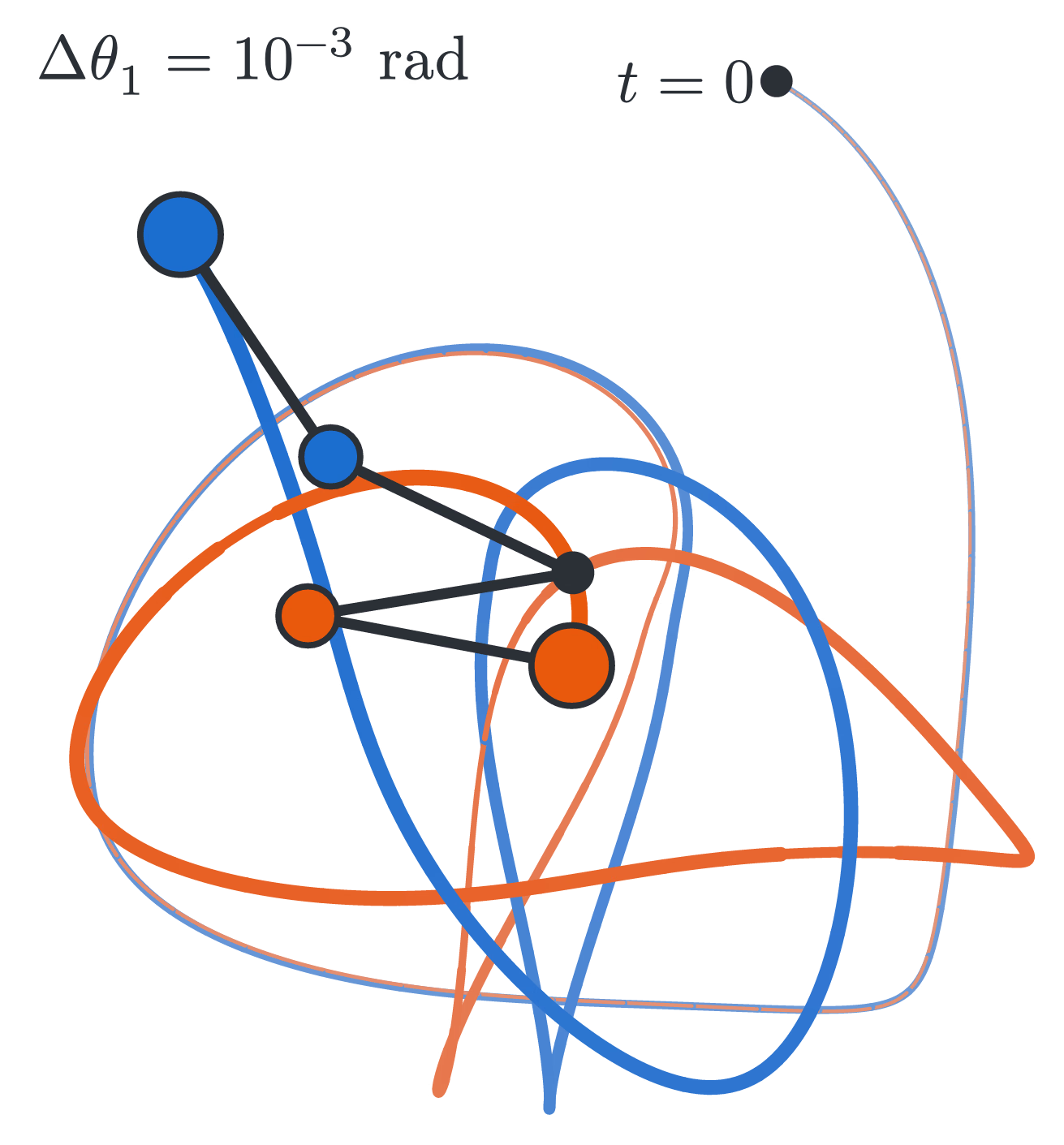
Two double pendulums (equal masses and rod lengths, released from rest at , ) whose upper angles differ by only rad. The exact Lagrangian equations of motion are integrated with fourth-order Runge-Kutta (, relative energy drift below ) directly in Typst. The traces of the lower bobs, fading in with time, coincide at first, then separate exponentially fast and end in completely different configurations, the hallmark of deterministic chaos and a positive Lyapunov exponent.
Download
Code
chaotic-double-pendulum.typ (127 lines)
#import "@preview/cetz:0.5.2": canvas, draw
#import draw: circle, content, line

#set page(width: auto, height: auto, margin: 8pt, fill: none)

// Double pendulum with equal masses and rod lengths (m = l = g = 1), state (θ1, θ2, ω1, ω2)
// with angles measured from the downward vertical. Exact Lagrangian equations of motion.
#let rhs(s) = {
  let (t1, t2, w1, w2) = s
  let d = t1 - t2
  let den = 3 - calc.cos(2 * d)
  let a1 = (
    (
      -3 * calc.sin(t1)
        - calc.sin(t1 - 2 * t2)
        - 2 * calc.sin(d) * (w2 * w2 + w1 * w1 * calc.cos(d))
    )
      / den
  )
  let a2 = 2 * calc.sin(d) * (2 * w1 * w1 + 2 * calc.cos(t1) + w2 * w2 * calc.cos(d)) / den
  (w1, w2, a1, a2)
}

#let axpy(s, h, k) = s.zip(k).map(((x, dx)) => x + h * dx)

#let rk4-step(s, h) = {
  let k1 = rhs(s)
  let k2 = rhs(axpy(s, h / 2, k1))
  let k3 = rhs(axpy(s, h / 2, k2))
  let k4 = rhs(axpy(s, h, k3))
  s.zip(k1, k2, k3, k4).map(((x, a, b, c, d)) => x + h / 6 * (a + 2 * b + 2 * c + d))
}

// Total energy, conserved by the exact dynamics (checks the integrator below)
#let energy(s) = {
  let (t1, t2, w1, w2) = s
  w1 * w1 + w2 * w2 / 2 + w1 * w2 * calc.cos(t1 - t2) - 2 * calc.cos(t1) - calc.cos(t2)
}

#let dt = 0.01
#let t-end = 14
#let n-steps = int(calc.round(t-end / dt))

// Integrate and return the full state history.
#let integrate(s0) = {
  let states = (s0,)
  let s = s0
  for _ in range(n-steps) {
    s = rk4-step(s, dt)
    states.push(s)
  }
  states
}

#let theta1 = 165deg.rad()
#let theta2 = 150deg.rad()
#let eps = 1e-3
#let run-a = integrate((theta1, theta2, 0.0, 0.0))
#let run-b = integrate((theta1 + eps, theta2, 0.0, 0.0))
#for run in (run-a, run-b) {
  let e0 = energy(run.first())
  assert(
    run.all(s => calc.abs(energy(s) - e0) < 1e-6 * calc.abs(e0)),
    message: "RK4 energy drift too large",
  )
}

#let joints(s) = {
  let (t1, t2, ..) = s
  let p1 = (calc.sin(t1), -calc.cos(t1))
  (p1, (p1.at(0) + calc.sin(t2), p1.at(1) - calc.cos(t2)))
}
#let bob-a = run-a.map(s => joints(s).at(1))
#let bob-b = run-b.map(s => joints(s).at(1))

#let col-a = rgb("#1c6dd0")
#let col-b = rgb("#e8590c")
#let ink = rgb("#2b2f36")

#canvas(length: 2.1cm, {
  // Lower-bob traces, fading from panel gray (early) to full color (late). Chunks of both runs
  // are interleaved so the later chunk always lies on top.
  let chunk = 10
  let n-chunks = calc.ceil(n-steps / chunk)
  let fade = rgb("#cdd3da")
  for c in range(n-chunks) {
    let i0 = c * chunk
    let i1 = calc.min(i0 + chunk, n-steps)
    let f = c / (n-chunks - 1)
    let width = 1.1pt + 2.5pt * f
    // While both bobs coincide, the orange run is drawn as a thin core on top of the blue
    // run (two-tone line); after they separate, both get the same width.
    let (qa, qb) = (bob-a.at(i1), bob-b.at(i1))
    let sep = calc.min(1, calc.norm(qa.at(0) - qb.at(0), qa.at(1) - qb.at(1)) / 0.5)
    let core = 0.45 + 0.55 * sep * sep * (3 - 2 * sep) // smoothstep from thin core to full width
    let mix = 0.45 + 0.55 * f
    for (bob, col, w) in ((bob-a, col-a, width), (bob-b, col-b, width * core)) {
      let paint = color.mix((col, 100% * mix), (fade, 100% * (1 - mix)))
      line(..bob.slice(i0, i1 + 1), stroke: (
        paint: paint,
        thickness: w,
        cap: "round",
        join: "round",
      ))
    }
  }

  // Initial position of the lower bob
  let start = bob-a.first()
  circle(start, radius: 0.06, fill: ink, stroke: none)
  content((rel: (-0.08, 0), to: start), anchor: "east", text(14pt, fill: ink)[$t = 0$])
  content((-2, 2), anchor: "north-west", text(14pt, fill: ink)[$Delta theta_1 = 10^(-3) "rad"$])

  // Pendulums at the final time
  let draw-pendulum(run, col) = {
    let (p1, p2) = joints(run.last())
    line((0, 0), p1, p2, stroke: (paint: ink, thickness: 2.4pt, cap: "round", join: "round"))
    circle(p1, radius: 0.11, fill: col, stroke: ink + 1.4pt)
    circle(p2, radius: 0.15, fill: col, stroke: ink + 1.4pt)
  }
  draw-pendulum(run-a, col-a)
  draw-pendulum(run-b, col-b)

  // Pivot
  circle((0, 0), radius: 0.08, fill: ink, stroke: none)
})