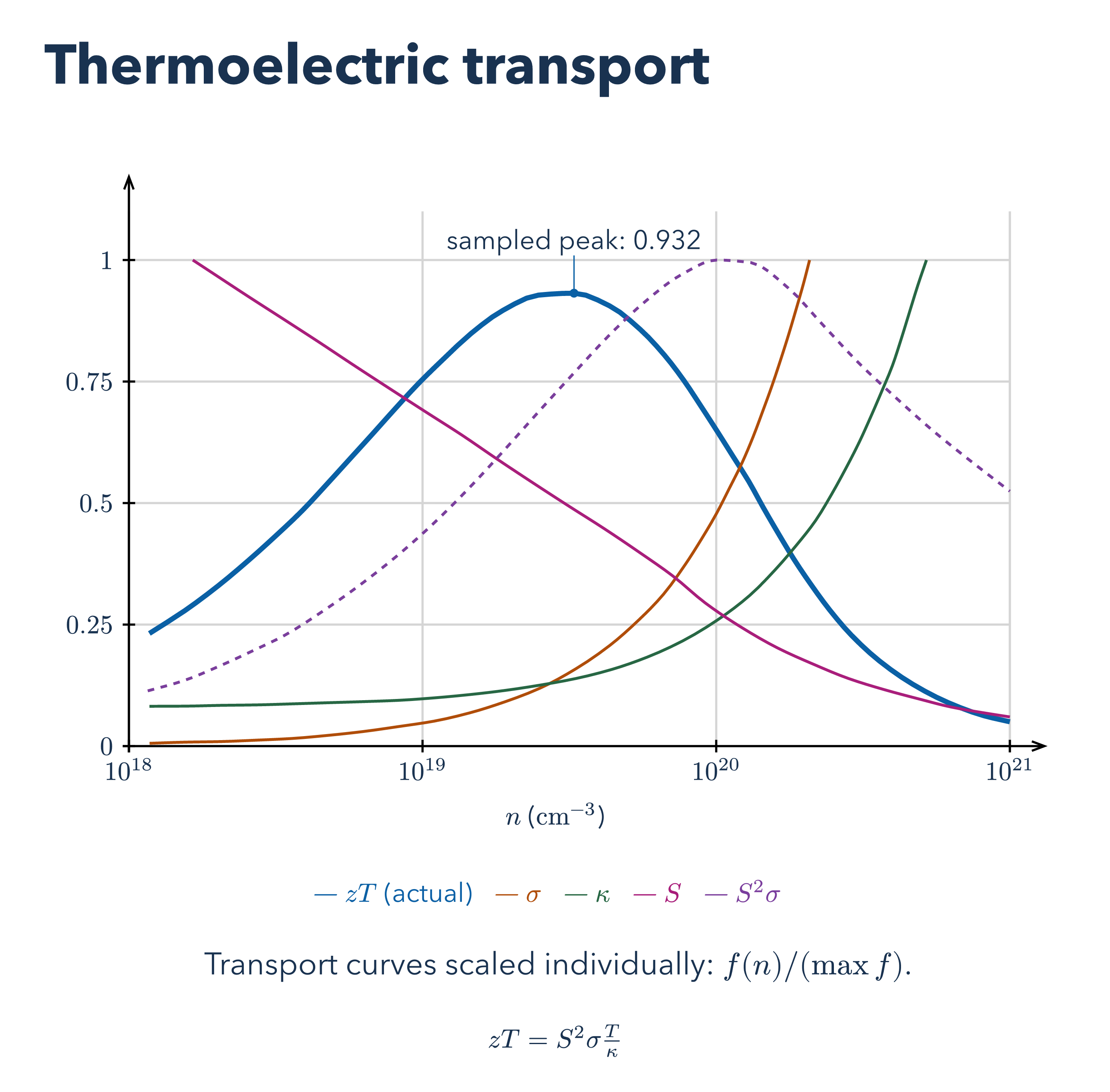
zT vs n
Digitized carrier-concentration dependence of the thermoelectric figure of merit , electrical conductivity , thermal conductivity , Seebeck coefficient and power factor of Bi₂Te₃. The thicker curve retains its actual dimensionless values; each transport curve is normalized by its own maximum among the digitized samples. Equal plotted heights therefore do not imply equal physical magnitudes. The labeled maximum is the largest digitized sample, not a fitted optimum. Thermal conductivity includes both electronic and lattice contributions. Adapted from α–ln σ plot as a thermoelectric material performance indicator.
Shape-preserving cubic interpolation in log carrier concentration smooths each curve to 100 rendering points. These are not additional measurements; the original points and sampled extrema are retained.
Download
Code
#import "@preview/cetz:0.5.3": canvas, draw
#import "@preview/cetz-plot:0.1.4": plot
#set page(width: 500pt, height: auto, margin: 20pt, fill: none)
#set text(font: "Avenir Next", size: 12pt, fill: rgb("#19324f"))
#set par(leading: 0.55em)

#let curves = (
  (
    label: $z T$,
    color: rgb("#0B5FA5"),
    points: (
      (1.174e18, 0.2317),
      (1.551e18, 0.2787),
      (2.016e18, 0.3300),
      (2.549e18, 0.3816),
      (3.171e18, 0.4332),
      (3.891e18, 0.4842),
      (4.697e18, 0.5373),
      (5.623e18, 0.5892),
      (6.714e18, 0.6404),
      (8.017e18, 0.6923),
      (9.650e18, 0.7450),
      (1.178e19, 0.7963),
      (1.461e19, 0.8486),
      (1.878e19, 0.8964),
      (2.481e19, 0.9278),
      (3.279e19, 0.9318),
      (4.334e19, 0.9057),
      (5.515e19, 0.8571),
      (6.662e19, 0.8045),
      (7.767e19, 0.7519),
      (8.859e19, 0.7000),
      (1.008e20, 0.6476),
      (1.143e20, 0.5953),
      (1.290e20, 0.5449),
      (1.447e20, 0.4906),
      (1.628e20, 0.4374),
      (1.837e20, 0.3850),
      (2.101e20, 0.3327),
      (2.436e20, 0.2799),
      (2.887e20, 0.2281),
      (3.594e20, 0.1753),
      (4.674e20, 0.1271),
      (6.178e20, 0.08917),
      (8.167e20, 0.06240),
      (1e21, 0.05),
    ),
  ),
  (
    label: $sigma$,
    color: rgb("#B04E09"),
    points: (
      (1.176e18, 0.005689),
      (1.554e18, 0.008070),
      (2.054e18, 0.009285),
      (2.714e18, 0.01216),
      (3.587e18, 0.01561),
      (4.740e18, 0.02190),
      (6.264e18, 0.02984),
      (8.277e18, 0.04013),
      (1.094e19, 0.05127),
      (1.445e19, 0.06820),
      (1.910e19, 0.09120),
      (2.511e19, 0.1191),
      (3.333e19, 0.1593),
      (4.344e19, 0.2072),
      (5.433e19, 0.2587),
      (6.613e19, 0.3123),
      (7.852e19, 0.3739),
      (8.925e19, 0.4266),
      (1.001e20, 0.4779),
      (1.110e20, 0.5310),
      (1.224e20, 0.5824),
      (1.335e20, 0.6359),
      (1.441e20, 0.6893),
      (1.551e20, 0.7425),
      (1.660e20, 0.7960),
      (1.767e20, 0.8478),
      (1.876e20, 0.9009),
      (1.986e20, 0.9532),
      (2.08e20, 1),
    ),
  ),
  (
    label: $kappa$,
    color: rgb("#286744"),
    points: (
      (1.175e18, 0.08187),
      (1.553e18, 0.08218),
      (2.053e18, 0.08379),
      (2.713e18, 0.08472),
      (3.585e18, 0.08684),
      (4.738e18, 0.08916),
      (6.261e18, 0.09142),
      (8.274e18, 0.09411),
      (1.093e19, 0.09912),
      (1.445e19, 0.1059),
      (1.909e19, 0.1145),
      (2.523e19, 0.1256),
      (3.334e19, 0.1391),
      (4.405e19, 0.1576),
      (5.821e19, 0.1830),
      (7.691e19, 0.2164),
      (1.016e20, 0.2605),
      (1.302e20, 0.3102),
      (1.589e20, 0.3629),
      (1.882e20, 0.4143),
      (2.181e20, 0.4641),
      (2.472e20, 0.5181),
      (2.764e20, 0.5714),
      (3.066e20, 0.6246),
      (3.363e20, 0.6780),
      (3.669e20, 0.7310),
      (3.981e20, 0.7826),
      (4.273e20, 0.8389),
      (4.560e20, 0.8942),
      (4.868e20, 0.9493),
      (5.2e20, 1),
    ),
  ),
  (
    label: $S$,
    color: rgb("#A81E7A"),
    points: (
      (1.65e18, 1),
      (1.931e18, 0.9729),
      (2.553e18, 0.9248),
      (3.375e18, 0.8777),
      (4.462e18, 0.8302),
      (5.899e18, 0.7816),
      (7.745e18, 0.7351),
      (1.031e19, 0.6866),
      (1.363e19, 0.6397),
      (1.802e19, 0.5897),
      (2.382e19, 0.5412),
      (3.149e19, 0.4937),
      (4.162e19, 0.4471),
      (5.503e19, 0.3977),
      (7.117e19, 0.3500),
      (9.181e19, 0.2944),
      (1.224e20, 0.2436),
      (1.618e20, 0.2019),
      (2.138e20, 0.1687),
      (2.826e20, 0.1389),
      (3.736e20, 0.1161),
      (4.938e20, 0.09646),
      (6.321e20, 0.08022),
      (8.578e20, 0.06624),
      (1e21, 0.06),
    ),
  ),
  (
    label: $S^2 sigma$,
    color: rgb("#7A3E9D"),
    points: (
      (1.159e18, 0.04006),
      (1.532e18, 0.04739),
      (2.025e18, 0.05790),
      (2.676e18, 0.06974),
      (3.386e18, 0.08033),
      (4.675e18, 0.09928),
      (6.179e18, 0.1176),
      (8.168e18, 0.1379),
      (1.080e19, 0.1608),
      (1.427e19, 0.1864),
      (1.886e19, 0.2142),
      (2.492e19, 0.2430),
      (3.294e19, 0.2713),
      (4.353e19, 0.2989),
      (5.754e19, 0.3230),
      (7.605e19, 0.3422),
      (1.005e20, 0.3528),
      (1.314e20, 0.3509),
      (1.757e20, 0.3326),
      (2.327e20, 0.3049),
      (3.071e20, 0.2777),
      (4.061e20, 0.2535),
      (5.369e20, 0.2304),
      (7.098e20, 0.2095),
      (1e21, 0.185),
    ),
  ),
)

#let normalize(points) = {
  let peak = calc.max(..points.map(point => point.at(1)))
  points.map(((carrier, value)) => (carrier, value / peak))
}
#let zt_peak = curves.first().points.sorted(key: point => point.at(1)).last()
// Monotone cubic Hermite interpolation in the plotted log-carrier coordinate.
// Zero slopes at extrema preserve the sampled peak; harmonic means avoid overshoot.
#let densify(points, sample_count: 100) = {
  assert(sample_count >= points.len(), message: "Sample count must retain every original point")
  let positions = points.map(point => calc.log(point.at(0), base: 10))
  let widths = positions.windows(2).map(pair => pair.last() - pair.first())
  let secants = points
    .windows(2)
    .zip(widths)
    .map(((pair, width)) => (pair.last().at(1) - pair.first().at(1)) / width)
  let slopes = (secants.first(),)
  for idx in range(1, points.len() - 1) {
    let before = secants.at(idx - 1)
    let after = secants.at(idx)
    let weight_before = 2 * widths.at(idx) + widths.at(idx - 1)
    let weight_after = widths.at(idx) + 2 * widths.at(idx - 1)
    slopes.push(if before * after <= 0 { 0 } else {
      (weight_before + weight_after) / (weight_before / before + weight_after / after)
    })
  }
  slopes.push(secants.last())
  let dense = ()
  let intervals = points.len() - 1
  for (idx, pair) in points.windows(2).enumerate() {
    let samples = (
      calc.floor((idx + 1) * (sample_count - 1) / intervals)
        - calc.floor(idx * (sample_count - 1) / intervals)
    )
    dense.push(pair.first())
    for step in range(1, samples) {
      let phase = step / samples
      let phase_squared = phase * phase
      let phase_cubed = phase_squared * phase
      let value = (
        (2 * phase_cubed - 3 * phase_squared + 1) * pair.first().at(1)
          + (phase_cubed - 2 * phase_squared + phase) * widths.at(idx) * slopes.at(idx)
          + (-2 * phase_cubed + 3 * phase_squared) * pair.last().at(1)
          + (phase_cubed - phase_squared) * widths.at(idx) * slopes.at(idx + 1)
      )
      dense.push((calc.pow(10, positions.at(idx) + phase * widths.at(idx)), value))
    }
  }
  dense.push(points.last())
  dense
}
// zT keeps its actual values; every transport curve is scaled to its own maximum.
#let plot_points = (
  curves
    .enumerate()
    .map(((idx, curve)) => densify(if idx == 0 { curve.points } else { normalize(curve.points) }))
)
#text(size: 25pt, weight: "bold")[Thermoelectric transport]
#v(12pt)
#align(center, canvas({
  draw.set-style(axes: (
    x: (label: (anchor: "north", offset: .1)),
    y: (label: (anchor: "north-west", offset: -.2)),
  ))
  plot.plot(
    size: (14, 8.5),
    name: "plot",
    axis-style: "left",
    x-mode: "log",
    x-min: 1e18,
    x-max: 1e21,
    x-tick-step: 1,
    x-format: value => $10^#calc.round(calc.log(value, base: 10))$,
    y-min: 0,
    y-max: 1.1,
    y-tick-step: .25,
    x-grid: true,
    y-grid: true,
    x-label: none,
    y-label: none,
    legend: none,
    {
      for (idx, curve) in curves.enumerate() {
        let thickness = if idx == 0 { 2.3pt } else { 1.3pt }
        let dash = if curve.label == $S^2 sigma$ { "dashed" } else { "solid" }
        plot.add(plot_points.at(idx), style: (
          stroke: (paint: curve.color, thickness: thickness, dash: dash),
        ))
      }
      plot.add-anchor("peak", zt_peak)
    },
  )
  draw.circle("plot.peak", radius: 2pt, fill: curves.first().color, stroke: none)
  draw.line("plot.peak", (rel: (0, .6)), stroke: curves.first().color + .6pt, name: "peak-leader")
  draw.content(
    "peak-leader.end",
    [sampled peak: #calc.round(zt_peak.at(1), digits: 3)],
    anchor: "south",
  )
  draw.content((rel: (0, -.4), to: "plot.south"), [$n$ ($"cm"^(-3)$)], anchor: "north")
}))
#v(10pt)
#align(center)[#for (idx, curve) in curves.enumerate() [#text(
    fill: curve.color,
  )[― #curve.label #if idx == 0 [(actual)]] #h(7pt)]]
#v(6pt)
#align(center, text(size: 14pt)[Transport curves scaled individually: $f(n) \/ (max f)$.])
#v(8pt)
#align(center)[$z T = S^2 sigma T / kappa$]